


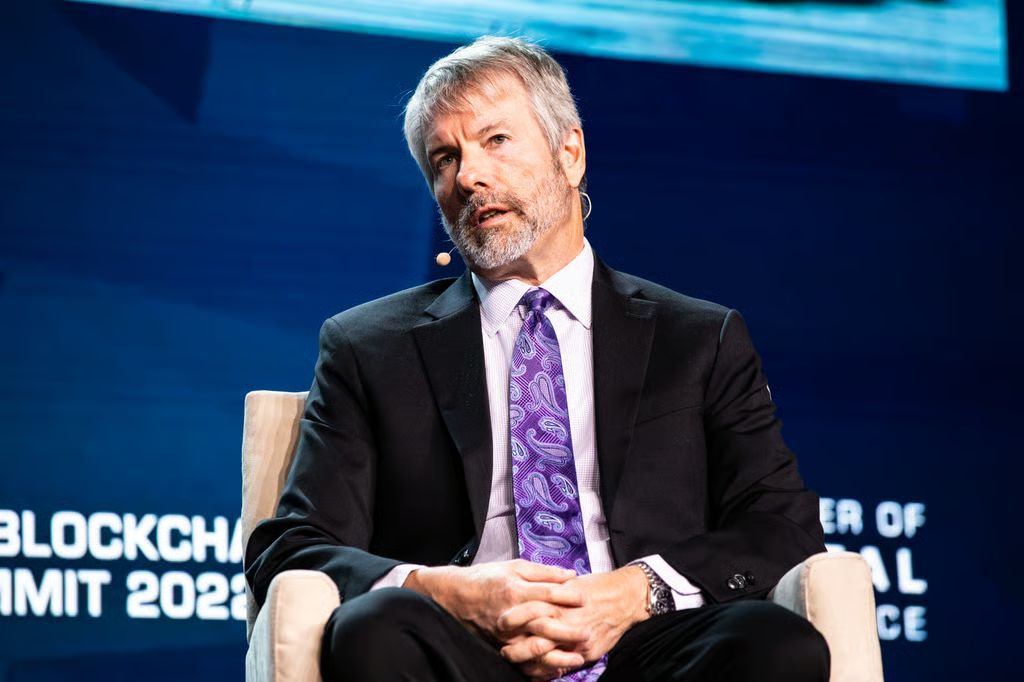
Strategy, formerly known as MicroStrategy, has held onto its position in the Nasdaq 100 during the latest rebalancing.
This marks the company’s first successful test since it joined the index in December last year.


Strategy is now the world’s largest corporate holder of Bitcoin. Its most recent purchase of 10,624 BTC for roughly $962.7 million brought its total holdings to 660,624 BTC.
Those holdings are worth nearly $60 billion.
Despite remaining in the index, Strategy’s stock closed down 3.74% on the day.
Shares have been declining for weeks, losing more than 15% over the past month.
Index Changes Reflect Shifts in Tech-Sector Composition
The Nasdaq 100 adjustments saw several major names removed, including Biogen, CDW, GlobalFoundries, Lululemon, On Semiconductor and Trade Desk.
Meanwhile, companies such as Alnylam Pharmaceuticals, Ferrovial, Insmed, Monolithic Power Systems, Seagate and Western Digital joined the index.
Strategy’s continued presence stood out because of its unusual business model.
Its heavy reliance on Bitcoin has raised questions about whether it resembles an operating company or an investment vehicle.
MSCI Review Raises Questions About Strategy’s Future Classification
The debate intensified when MSCI began reviewing firms with large crypto holdings.
The index provider has explored whether companies holding more than 50% of their assets in digital assets should be excluded.
This poses significant risk for Strategy.
JPMorgan analysts warned that up to $2.8 billion in Strategy shares could be sold by passive funds if MSCI removes it from the index.
In a letter to MSCI, Executive Chairman Michael Saylor and CEO Phong Le argued the firm is not simply stockpiling Bitcoin.
They wrote that Strategy issues preferred stock and other instruments to finance new purchases, positioning itself as an active operating company.
Company Raises $1.4 Billion to Address Market Concerns
Strategy recently raised $1.44 billion, aiming to ease fears about its ability to meet debt and dividend obligations if its share price declines further.
“There was FUD that was put out there that we wouldn’t be able to meet our dividend obligations, which causes people to pile into a short Bitcoin bet,” Le said.
Saylor has also been increasing engagement with institutional investors.
At the Bitcoin MENA conference in Abu Dhabi, he said he has been meeting with sovereign wealth funds, bankers and family offices.
He framed Bitcoin as “digital capital” and “digital gold.”
Saylor also argued that an emerging category of “digital credit” built on Bitcoin could offer yield with less volatility.
He has repeatedly emphasized his long-term goal of bringing large capital allocators into the Bitcoin ecosystem.